Resistance Bands
The portable, joint-friendly way to build real strength at home — no rack, no gym, no excuse.
Short answer: Short answer: resistance bands are one of the highest-return, lowest-risk pieces of home fitness gear you can buy. For under $20 you get a full-body strength tool that travels in a backpack, is safe on knees and shoulders, and scales from rehab to serious hypertrophy. The key is picking the right resistance range and a set with handles, a door anchor, and ankle straps.
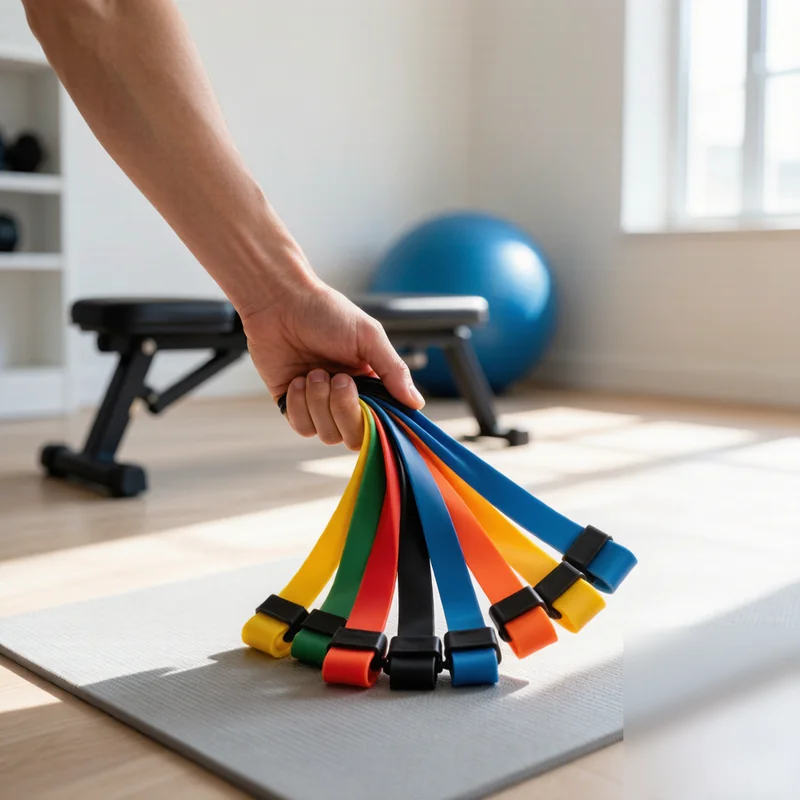
Why you might need it
Most people quit training not because they are lazy, but because the barrier is too high: a gym commute, a bulky rack, or a monthly fee. Resistance bands remove almost every barrier. They let a complete beginner do squats, rows, presses, and glute work in a bedroom. They are also the rare training tool that is genuinely easy on the joints — the tension is greatest at the top of the movement and eases at the stretch, which is the opposite of a loaded barbell. That makes them ideal for anyone coming back from a layoff, managing a cranky knee, or training around an old shoulder injury. For travellers and small-apartment dwellers they are the only sensible option: a full set weighs less than a pair of shoes.
The real problem it solves
The trap is buying one random band and expecting results. A single band has one resistance curve, so within two weeks you either outgrow it (too easy) or can't use it for lower body (too hard). The second trap is cheap bands that roll, snap, or smell of burnt rubber after a month. The third is missing accessories: without a door anchor you cannot do lat pulldowns or chest presses; without ankle straps you cannot train glutes or legs properly. If your "set" is just a loop with no handles, you will use it twice and forget it in a drawer.
How to choose & use it
- Pick a graduated set (light/medium/heavy) with handles, door anchor, and ankle straps — not a single loop.
- Warm up with the light band: band pull-aparts and shoulder dislocates for 2 minutes.
- Train major patterns: squat (stand on band, press up), row (anchor to door, pull), press (anchor high, push).
- Progress by band colour, not by guessing — when 12 clean reps feel easy, go one band heavier.
- Store rolled, out of direct sun; wipe with a damp cloth after sweaty sessions to avoid odour.
Key specifications
| Material | Natural latex (TPE for latex-free options) |
|---|---|
| Resistance range | Approx. 10–50 lb per band in a 5-band set |
| Included | Handles, door anchor, ankle straps, carry bag |
| Length | Typically 1.2–1.5 m per band |
| Best for | Home, travel, rehab, glutes, shoulders, mobility |
| Care | Wipe dry, keep out of direct sunlight to extend life |
How it compares
Single loop band only
ProsCheapest, takes no space
Watch outOne resistance curve, no handles, very limited exercises
Graduated handle set (recommended)
ProsFull-body workouts, scales with you, travels easy
Watch outSlightly more upfront cost
Adjustable cable machine
ProsSmooth, heavy loads
Watch outBulky, expensive, needs floor space — overkill for most
Beyond the basics
Resistance bands sit in a sweet spot that almost no other fitness product occupies: cheap enough to be impulse-proof, effective enough to genuinely change your body, and small enough to live in a drawer. That combination is why physiotherapists, travelling athletes, and apartment dwellers all keep a set within arm's reach.
The science is straightforward. Muscle grows from progressive tension taken close to failure, not from a specific type of steel or rubber. Bands deliver that tension, and because the load is 'accommodating' — hardest at the top of the rep where your leverages are strongest — they can feel surprisingly tough on pressing and rowing patterns. Many people underestimate a heavy band squat until their legs are shaking.
For building a routine, think in movement patterns rather than machines. You need a push (chest/shoulders), a pull (back), a hinge (glutes/hamstrings), and a squat (quads). Bands handle all four: press against a high door anchor, row from a low anchor, thrust the hips with a band around the knees, and stand on the band to press overhead or squat. Fifteen minutes, four patterns, full body.
One underrated use is warm-ups and mobility. Before any session, two minutes of band pull-aparts lights up the rear delts and wakes the posture muscles most desk jobs switch off. It is the single highest-leverage habit for anyone with rounded shoulders, and it costs nothing once the band is in your hand.
Where bands beat a gym membership is consistency. A $15 set removes the 'I'll go tomorrow' gap. Tomorrow becomes 'I'll do ten minutes now' because the gear is already on the floor. That ten minutes, done three times a week for a year, beats a January gym sprint that dies in February.
A practical note on quality: the market is flooded with identical-looking bands at wildly different prices, and the difference shows up months later. Reputable latex holds its colour and snap-resistance; bargain bins turn pale and brittle. Since a snapped band can whip painfully, this is one area where the few extra dollars genuinely buy safety, not just branding.
Finally, think of bands as a gateway, not a compromise. Plenty of people who cannot be bothered with the gym build surprising strength with a door anchor and thirty minutes. And when they later want more, the band routine they already have becomes the perfect warm-up for heavier training. It meets you where you are.
FAQ
Do resistance bands actually build muscle?
Yes — within the usual hypertrophy range of roughly 8–20 reps to near failure, bands provide enough tension to stimulate growth, especially for beginners and intermediates. They will not replace a 200 lb deadlift for a powerlifter, but for home strength and toning they are genuinely effective and well studied.
Which resistance should a beginner buy?
Buy a set, not a single band. A 5-band set that spans about 10–50 lb per band covers warm-up shoulders through heavy squats. You will quickly outgrow any single band, so the set pays for itself by keeping you challenged for months.
Are bands safe for knees and shoulders?
Generally yes, and often safer than free weights for people returning to training. The tension eases at the stretched position, reducing peak joint load. That said, always control the movement and avoid letting the band snap back uncontrolled.
How long do latex bands last?
A good set lasts 1–3 years with basic care: keep it out of direct sun, wipe sweat off, and don't over-stretch past its rating. Cheap no-name bands can dry and snap within months, which is why buying a recognised set matters more than buying the cheapest.
Can I use them for glutes specifically?
Absolutely. With ankle straps and a door anchor you can do kickbacks, seated abductions, and banded squats that directly target the glutes — this is one of the most popular at-home glute routines and works without any gym equipment.