Drawer Dividers
Turn a 'junk drawer' into a find-it-in-one-second drawer — without buying a new organizer every time.
Short answer: Short answer: drawer dividers are worth it for any drawer that currently looks like a junk pile — kitchen, desk, bathroom, or vanity. The right divider creates fixed compartments so every item has a home and you stop digging. Choose adjustable (spring-loaded or expandable) dividers for versatility, or fitted grid trays for small items like jewellery and tech.
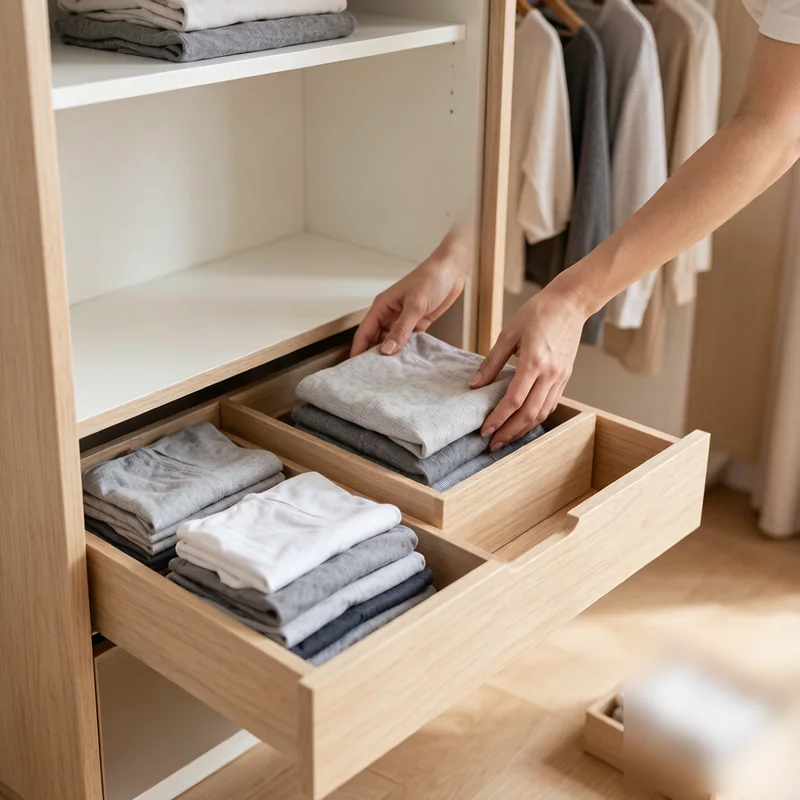
Why you might need it
A messy drawer is not a discipline problem, it is a design problem. When everything sits in one open box, the heaviest item sinks to the bottom and the thing you need is always under it. Dividers change the game by giving each category its own cell. You are not 'more organized' — you have removed the possibility of the mess re-forming. That is why a $13 set of dividers beats a $100 'smart drawer' every time: the structure, not the price, does the work.
The real problem it solves
The usual mistake is one fixed-size tray that does not fit the drawer, leaving dead space on the sides where clutter re-accumulates. Another is buying cute but flimsy plastic that warps, or compartments too shallow to hold anything useful. People also over-buy a single giant organizer and discover it only fits one drawer in the house. The result: a half-solved drawer that slides back into chaos.
How to choose & use it
- Empty the drawer completely and wipe it clean.
- Group items by category (tools, tech, beauty, stationery).
- Measure interior width; pick adjustable dividers or a fitted tray.
- Slot dividers to match your groups; leave daily items at the front.
- Return items one group per cell; review monthly and re-divide as needed.
Key specifications
| Material | Bamboo, PP plastic, or acrylic |
|---|---|
| Type | Expandable/spring-loaded or fitted grid tray |
| Adjustment | Many expand 28–46 cm to fit common drawers |
| Best for | Kitchen, desk, vanity, toolbox, medicine drawer |
| Install | Tool-free; friction or spring tension holds in place |
| Care | Wipe with damp cloth; bamboo benefits from occasional oiling |
How it compares
One fixed tray
ProsCheap, simple
Watch outWon't fit most drawers; dead side space fills with clutter
Adjustable expandable dividers (recommended)
ProsFits many drawer sizes, repositionable, long-lasting
Watch outSlightly more cost than a single tray
No system (status quo)
ProsZero spend
Watch outClutter returns within days; you keep digging
Beyond the basics
Drawer dividers are the quiet MVP of home organization because they attack the root cause of clutter rather than the symptom. A junk drawer is junk not because you are messy, but because nothing has a defined place — so everything pools together and the useful stuff buries itself.
The psychology is the interesting part. When a drawer has visible compartments, your brain treats each cell as a tiny commitment: this is where the USB cables go, this is where the spare batteries go. Returning items becomes automatic because the 'home' is obvious. Remove the compartments and the same person who was 'organized' last week is digging again. Structure beats willpower.
Adjustability is the feature that makes a set genuinely useful long-term. Drawers differ in width, depth, and what you store, so a rigid one-size tray fits maybe one drawer and fails the rest. Expandable dividers flex to the space and can be re-slotted as your needs change — birthday cards out, tax documents in. That adaptability is why one good set serves a whole home.
Material is mostly aesthetic and situational. Bamboo reads warm and suits a bathroom vanity or open shelving where the divider is visible. PP plastic is pragmatic for kitchen and toolbox use where wipe-clean matters more than looks. Acrylic is the premium, see-through option for jewellery. None of these outperform the others on function; pick by where the drawer lives.
The cheapest version of this upgrade is also the most underrated: an empty shoebox cut into sections, or a few ice-cube trays for tiny parts. But a purpose-built set looks better, lasts longer, and installs in ten seconds without scissors. For the price of a coffee, you buy back the minutes you currently spend hunting for a thumb drive every week.
The kitchen is where dividers pay back fastest. A single 'utensil drawer' usually hides three drawers' worth of chaos: spatulas, whisks, peelers, and a tangle of rubber bands. Give each its lane and cooking gets faster because you stop opening and closing to hunt. The same logic applies to a 'junk drawer' if you simply rename it a 'tools drawer' with cells for tape, batteries, and chargers.
One caveat: dividers are not decluttering. They organise what you keep; they do not make you keep less. If a drawer is full of things you have not touched in two years, the divider just tidies the hoard. The honest move is to declutter first, then divide, otherwise you build a beautiful system around stuff you should have let go.
FAQ
Do drawer dividers actually stay in place?
Good ones do. Expandable dividers use spring tension or friction against the drawer walls, so they hold without glue or screws. Fitted trays sit flush in a measured drawer. Cheap floppy plastic is the exception — that is why measuring first and choosing a recognised type matters more than buying the cheapest.
Adjustable or fitted — which should I buy?
If you want one set to use across several drawers (kitchen, desk, bath), adjustable expandable dividers win for flexibility. If a drawer holds many tiny identical items like jewellery or screws, a fitted grid tray with small cells is more precise. Many people end up owning both for different drawers.
Will they fit a non-standard drawer?
Measure the interior width and depth before ordering. Most adjustable dividers cover the common 28–46 cm range, which fits the majority of kitchen and desk drawers. For very wide or very narrow drawers, check the product's stated expansion range rather than guessing.
Are bamboo dividers better than plastic?
Bamboo looks warmer and is sturdy, and it suits visible drawers like a vanity. PP plastic is lighter, often cheaper, and easy to wipe. Neither is 'better' universally — choose by look and where the drawer lives. Both outperform a single fixed tray.
How do I stop the clutter coming back?
You mostly already have. With fixed cells, returning an item to its home takes one second, so the habit sticks. Do a 60-second review monthly: if a cell keeps overflowing, split it or move the item. The structure does the heavy lifting; you just maintain it.